
Cook County · ZIP 60133
A few years ago we would have steered most Hanover Park homeowners away from heat pumps. The technology caught up, and now the conversation is worth having in almost every home.
We are a local Fox Valley company based in North Aurora, about 34 minutes from our North Aurora shop, and we design heat pump systems around what Hanover Park homes actually are: compact 1960s–1980s single-family homes and townhomes — hardworking starter-home stock where honest repairs and sensible replacements matter most.
We size the system to the house, configure the changeover points honestly, and commission everything with instruments — because a heat pump only delivers its ratings when the install does.
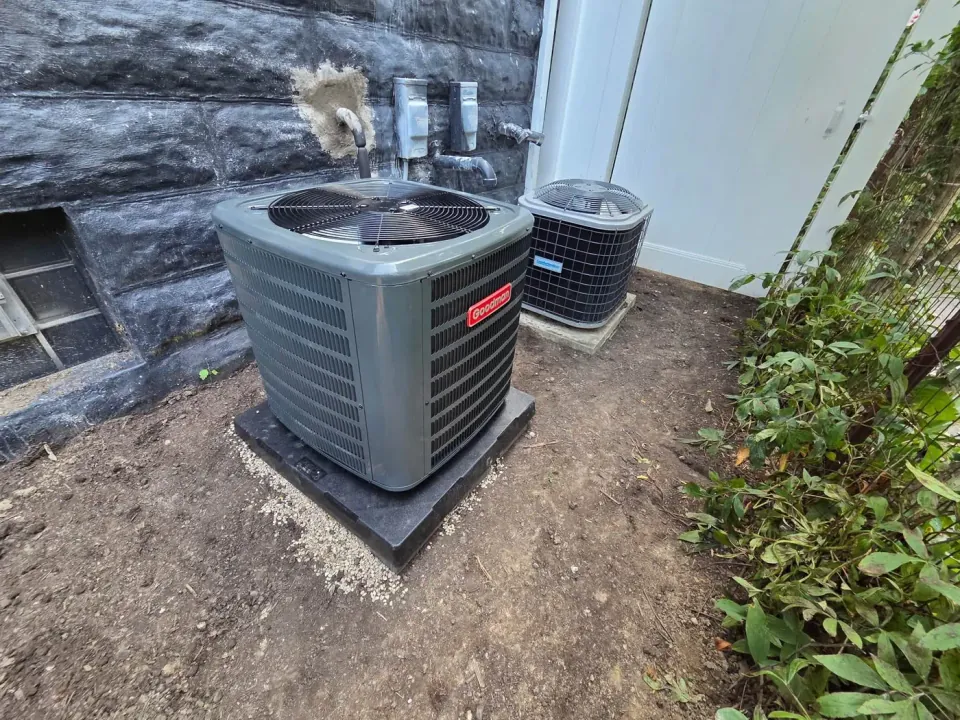
These are the situations where Hanover Park homeowners tend to come out ahead with a heat pump:
What to expect when Apex installs your heat pump:
Everything starts with the building: envelope, windows, duct capacity, and electrical panel all get measured before a model number enters the conversation. Copying the old furnace's size is how heat pumps end up leaning on expensive backup heat all winter — sizing to the house is how they earn their reputation. It is the same standard we bring to every Hanover Park visit.
Full cold-climate, dual-fuel hybrid, or not-yet — you hear the real comparison for your home, with balance points and backup heat explained in plain English and written options at more than one price. The strategy conversation is where Illinois heat pump projects succeed or fail, so we refuse to rush it. That is non-negotiable on our Hanover Park jobs.
Install day is where ratings become reality: the outdoor unit elevated for snow and defrost runoff, lines pressure-tested and pulled to deep vacuum, the charge weighed to spec, and every control — furnace integration included — wired the way the engineering intends.
We verify capacity and airflow with instruments, set the changeover and auxiliary heat lockout points so backup heat runs only when it should, register the warranty, and walk you through the thermostat — heat pumps run differently than furnaces, and knowing that up front prevents the classic first-winter surprises.
Heat pumps in Hanover Park live a harder life than the brochure assumes: compact 1960s–1980s single-family homes and townhomes — hardworking starter-home stock where honest repairs and sensible replacements matter most That is exactly why we design around the actual house — duct capacity, electrical panel, exposure — instead of quoting a model number off a chart.
The missteps that create heat pump horror stories:
The money conversation, Illinois edition:
Heat pump pricing moves with capacity, cold-climate rating, staging (single, two-stage, variable), and the design choice that matters most here: all-electric with backup heat versus dual-fuel with a gas furnace. Electrical panel work sometimes enters the picture too. That is a lot of levers — which is exactly why our quotes come after seeing the house, in writing, at more than one configuration and price. That policy has never once changed for a Hanover Park customer, and it will not start now.
Real customers, real Google reviews
“The Apex Climate Control technicians are simply the BEST!”
“Great service and quality work, thanks!”
Good to know
Usually, but it has to be verified — heat pumps move more air at lower temperatures than furnaces, so undersized or leaky ducts that a furnace muscled through will make a heat pump underperform. Duct evaluation is part of every quote we do; sometimes the honest recommendation includes fixing a duct problem first.
Here is the test that matters: not whether a heat pump runs at zero degrees (modern cold-climate units do), but whether YOUR design accounts for the output curve. Capacity declines as cold deepens — engineering fact — so the install either sizes for it with proper backup or pairs with gas in a hybrid. Design honestly and Cook County winters are a solved problem; skip the design and January grades the shortcut. Call 630-486-0401 and we will take it from there.
Depends entirely on the incumbent: against propane or baseboard electric, heat pumps usually win by a landslide. Against natural gas at Illinois rates, it is a genuine house-by-house calculation — utility prices, the unit's cold-weather efficiency, your usage pattern. We run your numbers instead of reciting anyone's slogan. We are about 34 minutes from our North Aurora shop, so help is close.
The maintenance logic is simple: one compressor, zero off-seasons. Twice-yearly service (pre-heating and pre-cooling) is the ideal; annual is the floor. Coils, charge, defrost operation, and electrical all get verified — because a machine that never rests earns its checkups faster than any other equipment in the house.
A heat pump paired with a gas furnace, sharing the same ductwork. The heat pump handles cooling and most of the heating season efficiently; when outdoor temperatures drop past the changeover point, the furnace takes over automatically. For many Illinois homes it is the best of both — electric efficiency most of the year, gas muscle for the deep cold.
That is a defrost cycle, and it is normal. Outdoor coils frost up in cold, humid weather; the unit periodically reverses briefly to melt it, producing a cloud of steam and sometimes a whooshing sound. Constant icing that never clears is a different story — that is a service call.
Plan on roughly 10–15 years for a hard-working Illinois heat pump — it runs all year, so it accumulates hours faster than an AC that sleeps through winter. Quality installation and annual maintenance push you toward the top of that range; skipping both pulls you below it.
One call reaches our local team — no national call center, no runaround. Serving Hanover Park and all of Cook County.
Or email support@apex-climate-control.com · Financing available with credit scores as low as 550