Kane County · ZIP 60120, 60123, 60124
The no-heat calls that fill our January schedule in Elgin almost always trace back to something a fall maintenance visit would have caught — a lazy igniter, a dirty flame sensor, a filter one month from collapse.
We maintain furnaces all over Elgin, where one of the region's oldest housing stocks — Victorians and early-1900s homes near downtown, postwar neighborhoods ringing them, and newer far-west subdivisions off Randall Road — so ductwork, radiator conversions, and equipment vintages span more than a century — and where equipment age and duty cycles vary enough that a real inspection matters.
Cleaning matters as much as testing — flame sensors, burners, and blower paths collect a year of dust that quietly degrades safety and efficiency.
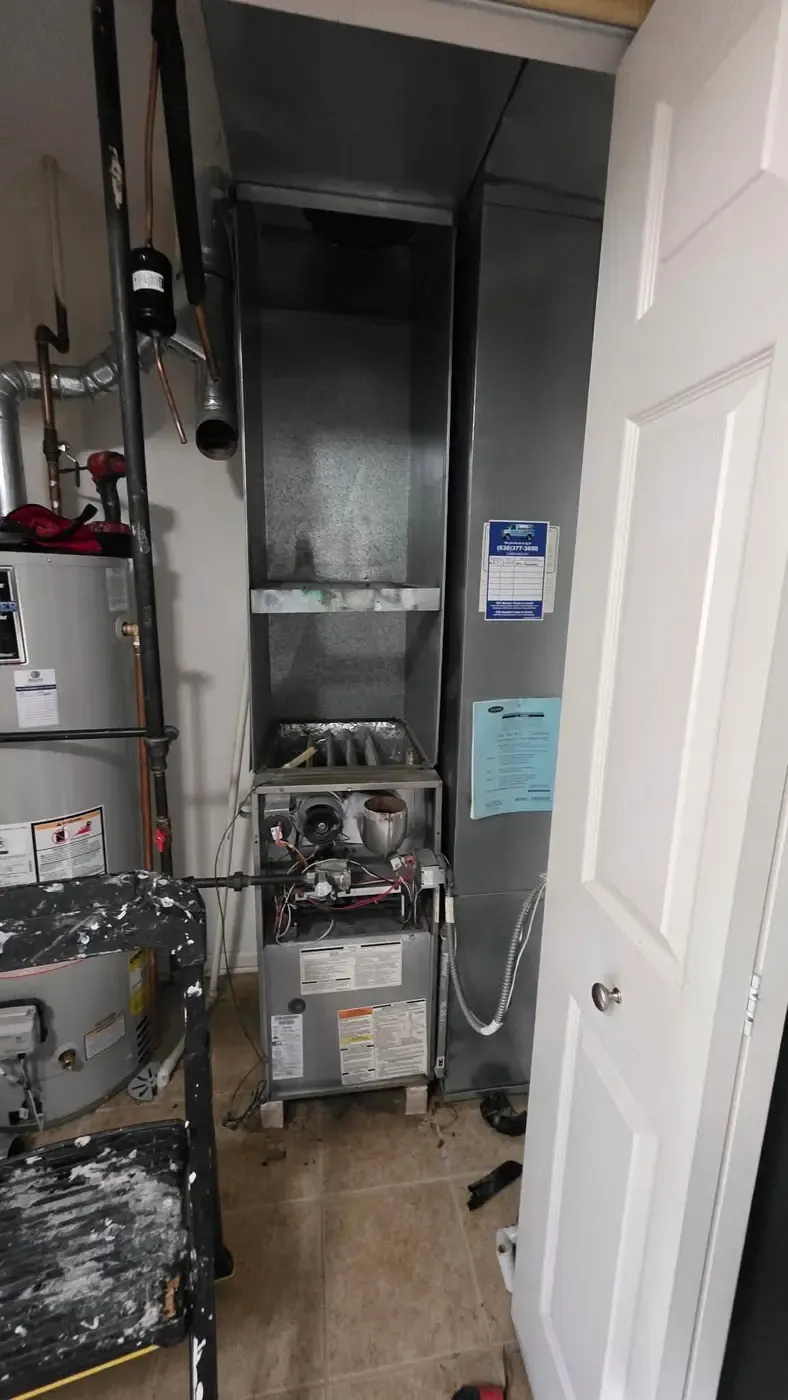
The tune-up checklist that actually prevents winter breakdowns:
The return on a furnace tune-up:
The parts that strand homes in January — igniters, flame sensors, pressure switches — telegraph their decline to anyone who tests them in October.
Carbon monoxide risks from a compromised heat exchanger or bad venting give no warning a homeowner can see. The annual inspection exists precisely because these failures hide.
Clean burners, correct airflow, and verified combustion mean the furnace extracts more heat from every therm across a very long heating season. We hold that line on every job in Kane County.
Furnaces that run within spec simply last longer. Overheating from restricted airflow is the quiet killer of heat exchangers and boards. It is the same standard we bring to every Elgin visit.
Kane County heating seasons are marathon-length: furnaces here log more runtime in one winter than systems in milder states log in three. In Elgin, where one of the region's oldest housing stocks — Victorians and early-1900s homes near downtown, postwar neighborhoods ringing them, and newer far-west subdivisions off Randall Road — so ductwork, radiator conversions, and equipment vintages span more than a century, annual maintenance is the difference between equipment that ages and equipment that fails.
Heating upkeep mistakes across Kane County:
What heating maintenance costs — and prevents:
The economics are lopsided on purpose: the parts that cause most winter no-heat calls — flame sensors, igniters showing wear, weak capacitors — telegraph their condition at a fall inspection. Catching them costs a service visit; missing them costs an emergency call in January, usually during the exact cold snap that finished them off. We are about 30 minutes from our North Aurora shop, and the estimate is always free of surprises.
Real customers, real Google reviews
“The Apex Climate Control technicians are simply the BEST!”
“Great service and quality work, thanks!”
Good to know
Every brand, every installer, everywhere we serve. Your furnace's history does not matter to us; its condition does.
Especially on a newer furnace, honestly: warranties typically expect documented annual service, and the first tune-ups are where install-era loose ends — gas pressure a hair off, a restrictive filter habit — get caught while they are trivia instead of history. Protecting a new furnace costs less than explaining an old one.
September or October is the sweet spot — ahead of sustained cold, with room to handle any findings on your own calendar instead of the weather's. Missed the window? A January tune-up still beats gambling on an untested furnace.
In this climate, yes. A Kane County furnace runs near-continuously for four-plus months; the flame sensor alone accumulates enough residue in a season to cause shutdowns. Annual service is also what most manufacturer warranties expect. Call 630-486-0401 and we will take it from there.
'Works fine' is what December furnaces say right before January proves otherwise. Running and running-within-spec are different facts, and only measurement separates them — that is the whole argument for a tune-up.
Typically about an hour, longer if the system needs deeper cleaning or turns up findings worth investigating on the spot.
It is the safety centerpiece of the visit: the heat exchanger keeps combustion byproducts out of your household air, and it endures thousands of heat-and-cool cycles per winter. We inspect for cracking and corrosion every fall because that is one failure mode that should always be found by a technician, never by a family. That has held true on every Elgin job we have run.
One call reaches our local team — no national call center, no runaround. Serving Elgin and all of Kane County.
Or email support@apex-climate-control.com · Financing available with credit scores as low as 550