
Kane County · ZIP 60510
Electric bills, gas prices, and better technology have put heat pumps on the table for Batavia homeowners — and we would rather give you the real trade-offs than a sales pitch.
We are a local Fox Valley company based in North Aurora, about 8 minutes from our North Aurora shop, and we design heat pump systems around what Batavia homes actually are: older limestone-era homes downtown alongside big 1980s and 90s neighborhoods on the east and west sides.
We size the system to the house, configure the changeover points honestly, and commission everything with instruments — because a heat pump only delivers its ratings when the install does.
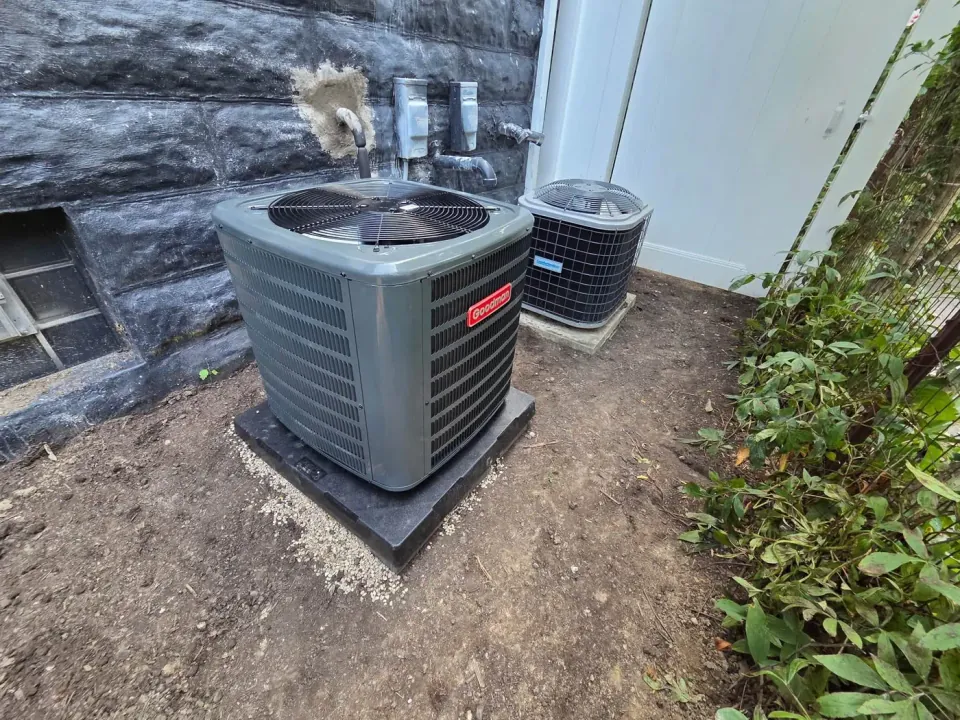
These are the situations where Batavia homeowners tend to come out ahead with a heat pump:
What to expect when Apex installs your heat pump:
We measure the house — envelope, windows, ductwork, electrical capacity — and design around it. Sizing a heat pump by the old furnace's label is how homeowners end up with expensive auxiliary heat running all winter; sizing to the building is how the efficiency actually shows up on the bill. No shortcuts on that step — not in Batavia, not anywhere.
You get the honest comparison for your house: full cold-climate heat pump, dual-fuel hybrid with gas backup, or keep-the-furnace-and-wait. Balance points, backup heat, and operating cost estimates are explained in plain English, with written options at more than one price.
Install day is where ratings become reality: the outdoor unit elevated for snow and defrost runoff, lines pressure-tested and pulled to deep vacuum, the charge weighed to spec, and every control — furnace integration included — wired the way the engineering intends. That is the difference homeowners in Batavia notice.
We verify capacity and airflow with instruments, set the changeover and auxiliary heat lockout points so backup heat runs only when it should, register the warranty, and walk you through the thermostat — heat pumps run differently than furnaces, and knowing that up front prevents the classic first-winter surprises.
We have run enough Kane County installs to know the local failure pattern: heat pumps that disappoint here were almost always sized or configured wrong, not the wrong technology. Getting the balance point and backup lockout right for Batavia winters is most of the game.
The missteps that create heat pump horror stories:
The money conversation, Illinois edition:
One cost warning from the repair side of our business: the cheapest heat pump install is routinely the most expensive one over ten years. Skipped load calculations, guessed charges, and default auxiliary settings show up later as electric bills and early failures. Whatever tier you choose, insist on commissioning — with us or anyone. That policy has never once changed for a Batavia customer, and it will not start now.
Real customers, real Google reviews
“The Apex Climate Control technicians are simply the BEST!”
“Great service and quality work, thanks!”
Good to know
Usually, but it has to be verified — heat pumps move more air at lower temperatures than furnaces, so undersized or leaky ducts that a furnace muscled through will make a heat pump underperform. Duct evaluation is part of every quote we do; sometimes the honest recommendation includes fixing a duct problem first.
Yes — with the right equipment and design. Cold-climate models have transformed what heat pumps can do in deep cold, holding useful output well below zero. The engineering honesty: capacity still declines as temperatures drop, so the design must account for it — either proper cold-climate sizing with backup, or a dual-fuel pairing where gas handles the extremes. Done right, they work here; done carelessly, January exposes it.
It depends on what you heat with now. Replacing propane or electric-resistance heat, the savings are usually dramatic. Against natural gas, the answer moves with utility rates and how efficiently the system runs in cold weather — which is exactly why we run the comparison for your house and your rates instead of promising a universal answer.
Think of it as AC maintenance with double the stakes: the same coils, charge, and electrical checks, plus defrost operation — annually at minimum, ideally twice a year since it works both seasons. One compressor carrying the whole year's load is exactly the machine you want looked after.
It is the pairing built for climates like ours: heat pump and gas furnace on shared ductwork, with automatic handoff. Electric efficiency carries the shoulder seasons and moderate cold; when the thermometer dives, the furnace takes the baton without you touching anything. Most of the Illinois heat pump installs we are proudest of are hybrids. We would rather you ask than guess.
That is a defrost cycle, and it is normal. Outdoor coils frost up in cold, humid weather; the unit periodically reverses briefly to melt it, producing a cloud of steam and sometimes a whooshing sound. Constant icing that never clears is a different story — that is a service call. Call 630-486-0401 and we will take it from there.
Plan on roughly 10–15 years for a hard-working Illinois heat pump — it runs all year, so it accumulates hours faster than an AC that sleeps through winter. Quality installation and annual maintenance push you toward the top of that range; skipping both pulls you below it.
One call reaches our local team — no national call center, no runaround. Serving Batavia and all of Kane County.
Or email support@apex-climate-control.com · Financing available with credit scores as low as 550