
Homeowner guide
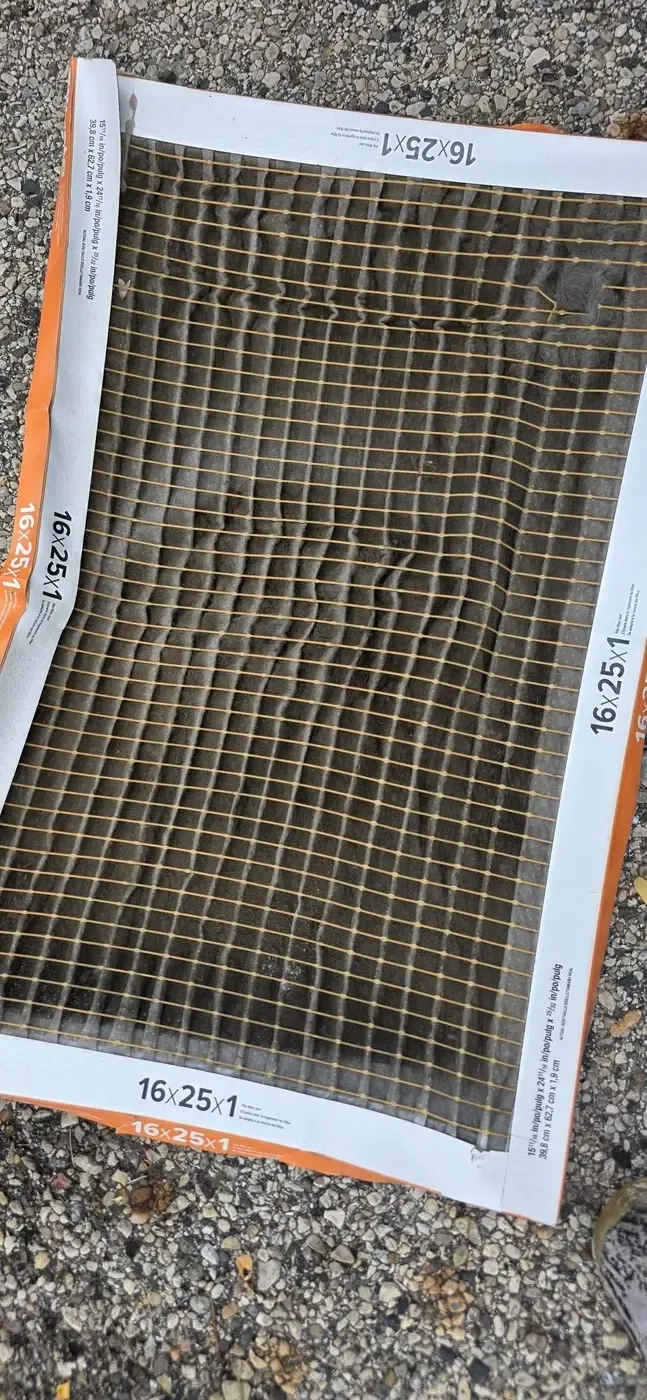
The air filter is the cheapest part of your entire HVAC system and the root cause of a remarkable share of the expensive calls we run. Here's what actually happens downstream of a filter that should have been changed months ago.
Your blower is designed to move a specific volume of air across the heat exchanger in winter and the evaporator coil in summer. A loaded filter is a wall in front of that airflow. The blower strains, the air volume drops, and both the heating and cooling sides start operating outside their design — in opposite but equally damaging directions.
With too little warm air crossing it, the evaporator coil gets colder than designed, condensation freezes, and ice further blocks airflow in a feedback loop — until you have a solid block of ice, warm air at the registers, and potentially water damage as it thaws. Run it that way long enough and liquid refrigerant heads back toward the compressor, which is how a $10 filter graduates into the most expensive repair in the system.
Too little air across the heat exchanger means heat builds inside the furnace until the high-limit safety shuts the burners down. The furnace short cycles — heat, trip, cool, retry — delivering poor comfort while thermally stressing the heat exchanger with every loop. Repeated overheating is a leading contributor to cracked heat exchangers, which is a furnace-ending (and safety-critical) failure.
Check monthly during heavy heating and cooling season; change when you can't see light through it. Households with pets, allergies, or renovation dust need shorter intervals. If filters are loading unusually fast, that's a signal worth investigating — often the ductwork itself is carrying years of accumulation that reloads every new filter, which is exactly what a duct cleaning with video inspection settles. Questions? 630-486-0401.
Talk to a real local team about your heating, cooling, or indoor air problem — no call centers, no runaround.
Or email support@apex-climate-control.com · Financing available with credit scores as low as 550